
I know the feeling. The words aren’t quite coming the way that you envisioned when you had the idea in the shower yesterday. The story isn’t really coalescing around the awesome concept that you can see in your head. Writer’s Block is rearing its head. Maybe your other obligations are calling, demanding your attention instead. You can see the writing on the wall. The urge is there. The urge to close the document and move on to a new project. Well… I’m here to tell you, moving on may not be the best idea, and you really should finish that work in progress.

You Can’t Edit a Blank Page
If I had a penny for every quote about giving some grace to your first draft… well, I could afford to be a writer full time. But all of them are true. Without even a cruddy finished product, you don’t have anything to improve upon. Something is always better than nothing.
It is completely normal for the first draft to bear only a passing resemblance to the vision that first entered your head. The entire purpose of the first draft is to get that vision out of your head and onto the paper. Or screen. Or stone tablet. Whatever floats your catamaran. Just because it looks like the child’s fingerpainted version of the vision is no reason to walk away from it unfinished. As Hemingway once said, “the first draft of anything is shit.”
“The first draft of anything is shit.”
Ernest Hemingway
If you persevere and give the story an ending, even a crappy one, you can always change it. The first draft is just that, a first try at the thing. It isn’t ever the draft that you are going to share with the world. It’s allowed to be, as Hemingway so eloquently put it, shit. But if you finish it, you can improve it.
Finishing The Story Is a Skill to Practice
Finishing a story is the second hardest part of writing it, at least for me. Second only to starting it. It is so easy to get a good idea rolling, and then have it fizzle and die, an unfinished tale hiding forever in the depths of my Documents folder.
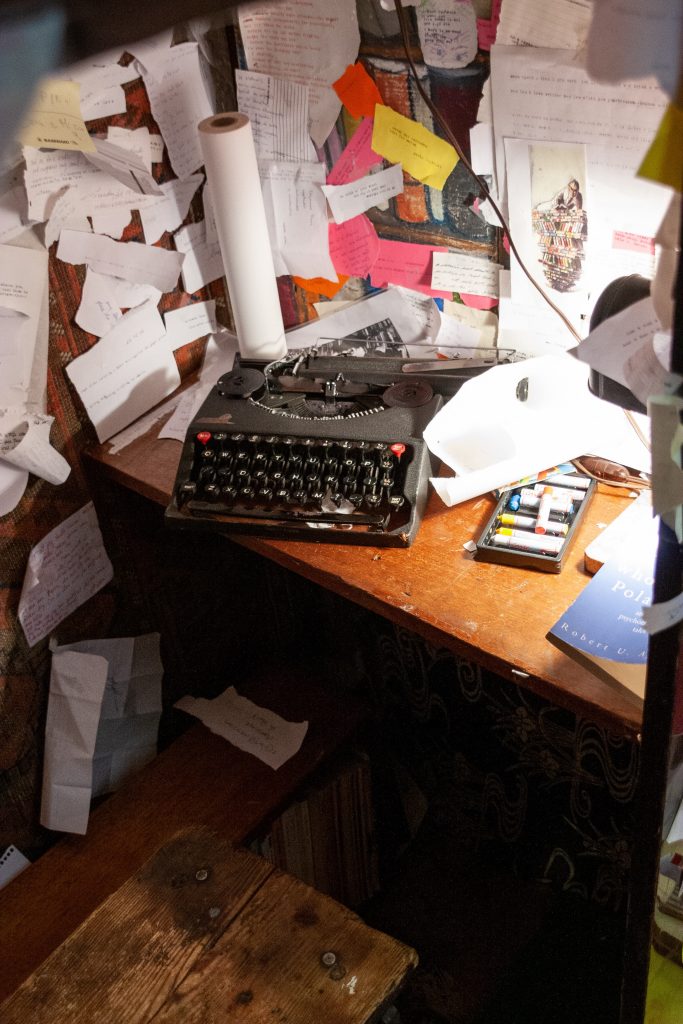
But that doesn’t teach me anything. It doesn’t allow me to practice a critical part of storycraft. I haven’t practiced the vital skill of finishing a story. I haven’t even practiced it badly enough to get to practice editing it.
It doesn’t get any more simple than that. Finish the story. It’s kind of like eating vegetables. You’ll be a better writer for it.
Finishing a story is harder if I write by seeing where the story takes me. One of the best ways to ensure that you find the finish line is to define where it is from the beginning. That isn’t to say that you always need an outline, or that you can never write by the seat of your pants. Just that, for me personally (and maybe for you, too), the odds of running into a slump or issues working out the ending go up significantly if I’m relying on my story or characters to figure it out on their own. That being said, if I can push through and beg the characters to do just that, sometimes the endings that they arrive at are better than anything I could have planned.
A Finished Story Opens Doors
Whether you’re an indie author or looking to be published along more traditional routes, you don’t have much unless you have something marketable. And the first step toward marketable is finished.
With a finished story, whether a shorter piece or a full-length novel, you have something to move forward with. It might be rough, it probably needs some edits and tweaks. But it has a beginning, a middle, and an end. It is complete. And, if your endgame as a writer includes publication of any kind, that’s pretty much the barest minimum of need to have a thing to sell, or to otherwise share with the world. Having the finished product in-hand literally opens the door to the opportunity to share it, along with, when you inevitably receive your rejection letters, the opportunity to improve it.
Without a finished piece, you don’t have something to submit for publication. To query to an agent. To post to your blog. Or to send to your cousin in Indiana who loves reading your stories. A finished story is something you can share with the world.
If this article brought you some encouragement, you may also enjoy this one, where I cover when it is actually time to move on from a creative project. You can also find me on Twitter, Instagram, or have content automatically delivered to your inbox via subscription to my monthly newsletter!
Until next time, may the Muse be with you, finish that story, and write on!
Be First to Comment