
“Be steady and well ordered in your life so that you can be fierce and original in your work”
Gustave Flaubert
The image of the messy, disorganized creative is an easy stereotype to visualize. An artist, surrounded by dropcloths, paint supplies, and projects. The author in the center of a sea of papers and books, tapping away at his keyboard. The filmmaker so engrossed in her work that she loses track of other elements of her life.

Why do we have these stereotypes? Is there something to this idea of the disorganized and chaotic lifestyle of the creative? And is the alternative, a lifestyle of structure and order, as Flaubert suggests, perhaps a route to greater creativity and originality?
Chaos and the Creative
Part of this image of the chaotic, disorganized creative comes down to the nature of creativity itself. The act of creation is one of confronting chaos, of exploring what lies beyond our familiarity and understanding. Artists, regardless of medium, have their playground in the space where anything can happen. That is the very definition of chaos.
This exploration of chaos is important. It isn’t a bad thing. This is part of the role of the artist in society. And on a much smaller scale, as individuals we each, artist or not, need to confront the unexplored, the unfamiliar, the “what if” spaces in the world around us. To fail to do so is to court an entirely different set of problems. Without engaging with the chaotic, people stagnate, fail to grow and evolve, and fall far short of their potential. For the creative, failing to explore beyond the familiar results in work that is boring, derivative, and predictable.
But there is danger in too much chaos, too. Stories, modern and historical, abound of artists who tread close to the chaotic edge in all areas of life. Their artistic work is regarded as genius, but in the most extreme examples their lives are cut tragically short.
Balancing Bandwidth
The problem that arises when exploring chaos is that humans need order, too. It varies from person to person, of course, but without a little bit of order imposed in our world things can fall apart fast.
Engaging with chaos takes mental bandwidth. It’s exhausting, dealing with anything and everything on a popup basis. After long enough, it burns people out, at a minimum.

In the quote that opens this post, Gustave Flaubert suggests that orderliness in life allows greater originality in creative work. This is easy to observe in high profile high performers in general; a great example is the “personal uniform” that some celebrity creatives and CEOs adopt. This strict orderliness in wardrobe frees up bandwidth for creativity and decisionmaking on their passions.
Putting the Idea to Work in Real Life
So, if this idea works for Mark Zuckerberg and Barack Obama, how do we everyday creatives channel Flaubert’s admonition? How do we get our life in order for creativity?
Plan and Schedule
If you’re reading this, you probably are the kind of writer or creative who is fitting their passion around a few other life obligations. Day jobs that put bread on the table and keep the WiFi on. Supporting the friends and family who support us and our creative passions. Even the basic behaviors of functional life.
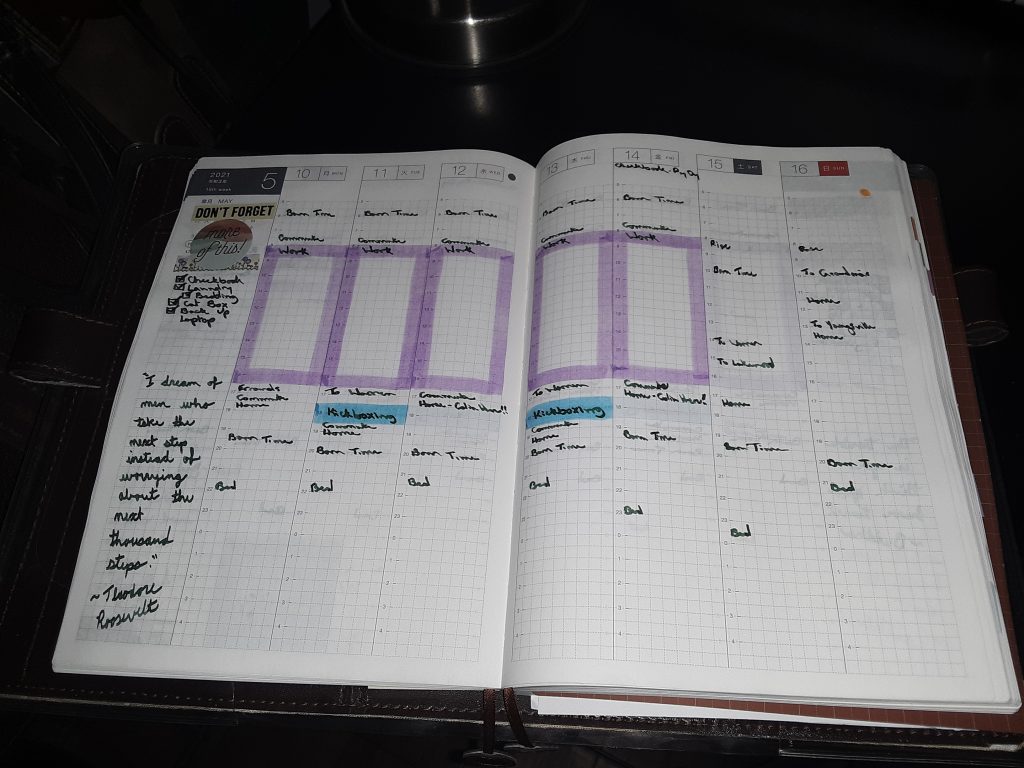
I’ve written about setting aside time for creative work before, in this post inspired by Eric Maisel’s book about all the ways that we can create space for writing. But it bears saying again. The calendar or schedule is the temporal answer to the idea of “a place for everything and everything in its place.” And the beauty of it is that it is your schedule! You, for the most part, have a lot of control over what goes on it!
Your schedule is a tool to help you be steady and ordered in your life. It gives you a scaffold to hang your days on, and a way to visualize the time that you have and the tasks that you have decided need to fit into it.
Within the broader concept of scheduling, some folks take it to an extreme; calendar blocking every minute of the day. That amount of rigidity doesn’t work for me personally, at least for long terms and in all aspects of life. And that’s the beauty of the schedule. It can be exactly the structure that you need it to be for your purposes.
Routine and Habit
Where I become more rigid is in the realm of routine and habit. These are the areas where you create, by purpose or accident, patterns of behavior. While I don’t necessarily calendar block my routines, I do have a habit of doing certain repeating tasks on certain days.
These routines and habits allow me to go on “autopilot” for life-sustaining recurring basics like laundry, shopping, and bills. Instead of being surprised by a lack of socks and having to spend time and bandwidth solving that problem, I just throw in the week’s laundry on Sunday night before bed, the cycle starts, and I don’t think about it for the rest of the week. I’m a little freer to think about how to end a story, or where to submit it, and where the next story is coming from.

My particular system probably won’t work for you – we all have our own lives with our own needs, and how I do my thing may not mesh at all with your world. And that’s great! But I can definitely speak to the creative value of a system that reduces mundane problem solving.
Systems for Seasons
The system that works for you won’t work forever. Even over the course of a single year, the routine and order that you build into your world will need to adjust and evolve based on external factors. The universe cannot, should not, be forced into order, and the shifts provide awesome fodder for creative work. Let your order breathe when it needs to.
As we shift full-tilt into the summer season in my own local latitude, I find my routines shifting as well. More outdoor projects, farm chores become less time-intensive because the weather isn’t a battle. I have more time through the week now to write, but weekends are a lot more active. So, I adjust for the season.
Some seasons are longer than three months. The season of life as a student. As a corporate wage-slave. As a parent, or a retiree. These season that you are in is going to have input on the order of your life, in the same way as a blizzard imposes boots on your feet rather than sandals. You should not feel negatively if the season of your life imposes a particular, less-Instagrammable kind of order and steadiness on you for a while.
How Do You Use Order for Creativity?
Do you agree with Flaubert? Should we strive to be steady and ordered in our everyday lives to save the best of our chaos-facing selves for our creative work? Or does the chaos in your everyday doings actually feed your creative flow? Let me know in the comments.
If this article brought you some encouragement or made you think, you may also enjoy this one, where I consider thoughts and strategies for how to fit your creativity in among the demands of everyday life. You can also find me on Twitter, Instagram, or have content automatically delivered to your inbox via subscription to my monthly newsletter!
Until next time, pour yourself a fresh cup of your preferred poison, may the Muse be with you, and write on!
Be First to Comment