
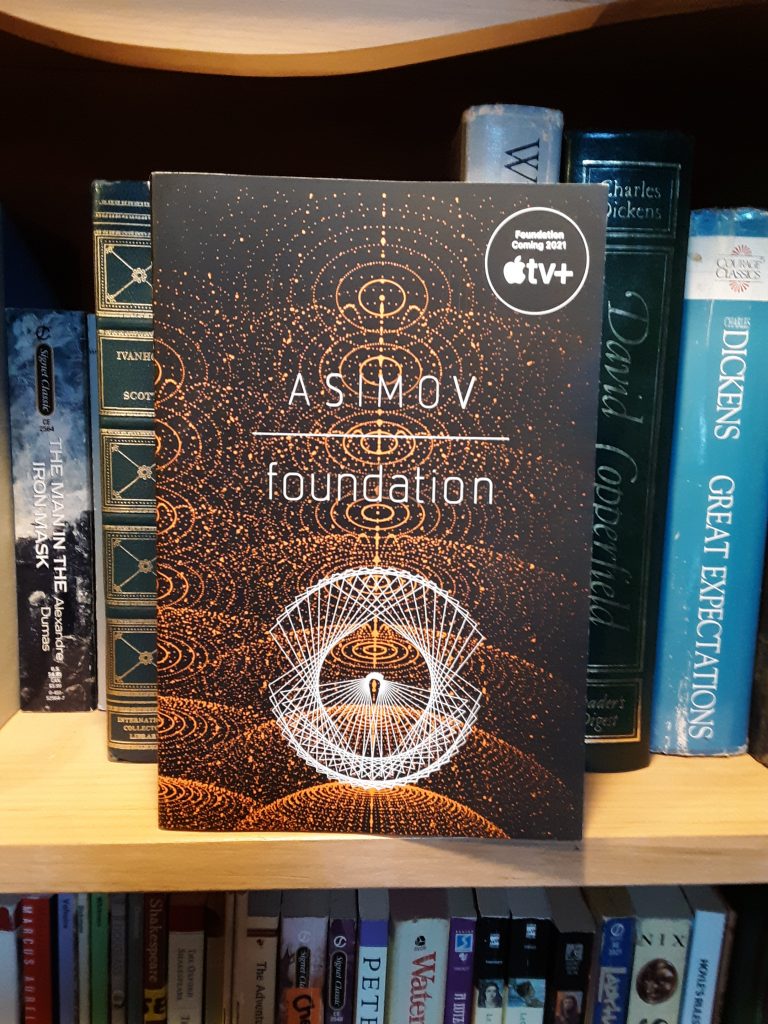
Foundation first came to my attention, oddly enough, in a news byte regarding the the planning of the AppleTV series. Apparently I’m not as well-versed in the great Isaac Asimov’s bibliography as I originally thought! By personal habit, if I can, I always shoot to read the book before I see the film adaptation. Naturally, the first of this series was an instant add to my “to read” list.
I don’t subscribe to AppleTV; at the moment, Foundation is the only offering there that’s caught my eye, and one intriguing show isn’t enough for me to add another subscription. Recent reviews support my suspicion that it’s being adapted in a different direction than the books. So, despite my enjoyment of the book, which I’ll get into, I’m less obsessed with catching the adaptation on screen.
Setting and Context
I can easily see why there are opinions that Foundation, like Dune, defies adaptation. This is not a straightforward tale, not the simple heroic arc story in which we follow a character from the beginning to the end. This is not that kind of story.
Foundation is the tale of an intergenerational initiative to save a future interstellar humanity from millennia of economic and cultural misery following the immanent collapse of the central Empire. Dr. Hari Seldon, a genius in the field of psychohistory, is the architect. On the capital city planet of Trantor, Seldon’s warnings of imperial collapse are initially received as treason. The Emperor’s courtiers exile Seldon to a pair of planets on opposite fringes of the galaxy where he establishes the Foundation.
Structure
In the context above, the story of the Foundation’s ensuing activities unfolds. This is where the story gets complicated. Much of the media that we consume follows some form of the three-act story structure, with a hero who we follow along a journey in an upward arc, or perhaps a tragic downward arc.
Foundation does NOT follow this kind of structure. While Seldon is arguably the hero of the story, he is personally absent after the initial setup of the Foundation. The narrative instead is episodic, following the Foundation’s generations as they negotiate their mission and the unraveling of the Empire’s influence in the galactic periphery. The connecting thread of each episode is the increasingly-distant past chessmastery of Seldon.
The Science in the Fiction
An additional difference between Foundation and the more typical sci-fi story is that the conflicts, while high-stakes, tend not to feature dramatic space battles, alien invasions, and so forth. The Foundation, by Seldon’s design, must operate through more subtle means. Politics, religion, and economics are the tools that the Foundation uses to survive and carry out its mission. That’s not to say that the story isn’t riveting. And there are certainly scenes that would make for dramatic visuals in adaptation. But the focus is not on laser swords and starships. It’s on the relationships that the Foundation must manage with its neighbors and rivals.
The science fiction elements seemed somewhat softer to me than in some of Asimov’s other works. Nuclear power is a major plot element, the closest thing to a “MacGuffin” in the story, and the Foundation’s greatest material asset. But the Foundation itself frames nuclear power as a magic, controlled by a planned religion that it disperses through the star systems. The abilities of nuclear power stretch into almost-magical territory in Asimov’s galaxy. This is truly the frontier where sufficiently advanced science becomes indistinguishable from magic, and the Foundation leans hard into this tendency to survive.
Takeaways
I very much enjoyed Foundation. This is the first installment of a series, and I will of course be picking up the sequels. In a way, I would recommend this read to someone who enjoys A Song of Ice and Fire for its political elements and back-room plotting and scheming. Fans of political thrillers in general would probably enjoy it, even if they don’t have a strong preference for science fiction.
I don’t think I’ll be springing for AppleTV at this point, but if I trip over an opportunity to watch the series I’ll take it. I were adapting this story, I would treat it as an anthology, letting each episode of the story have it’s characters and its story step forward and shine as Asimov did. Seldon’s great plan and the Foundation’s mission could then become the frame, the line that connects each crisis. There is no one hero to follow, nor even one crisis to navigate. This is a generational story, the tale of an entire civilization.
Have you read Foundation yet? Or seen the AppleTV adaptation? What did you think? Share your thoughts in the comments; I’d love to hear from you!
If you’ve enjoyed this book review, you can check out another of my recent reads, Death Comes to Pemberley, by P.D. James. I don’t always review the books that I read, and I don’t get any kind of kickback for it – I simply like to share.
Until next time, happy reading!
Be First to Comment