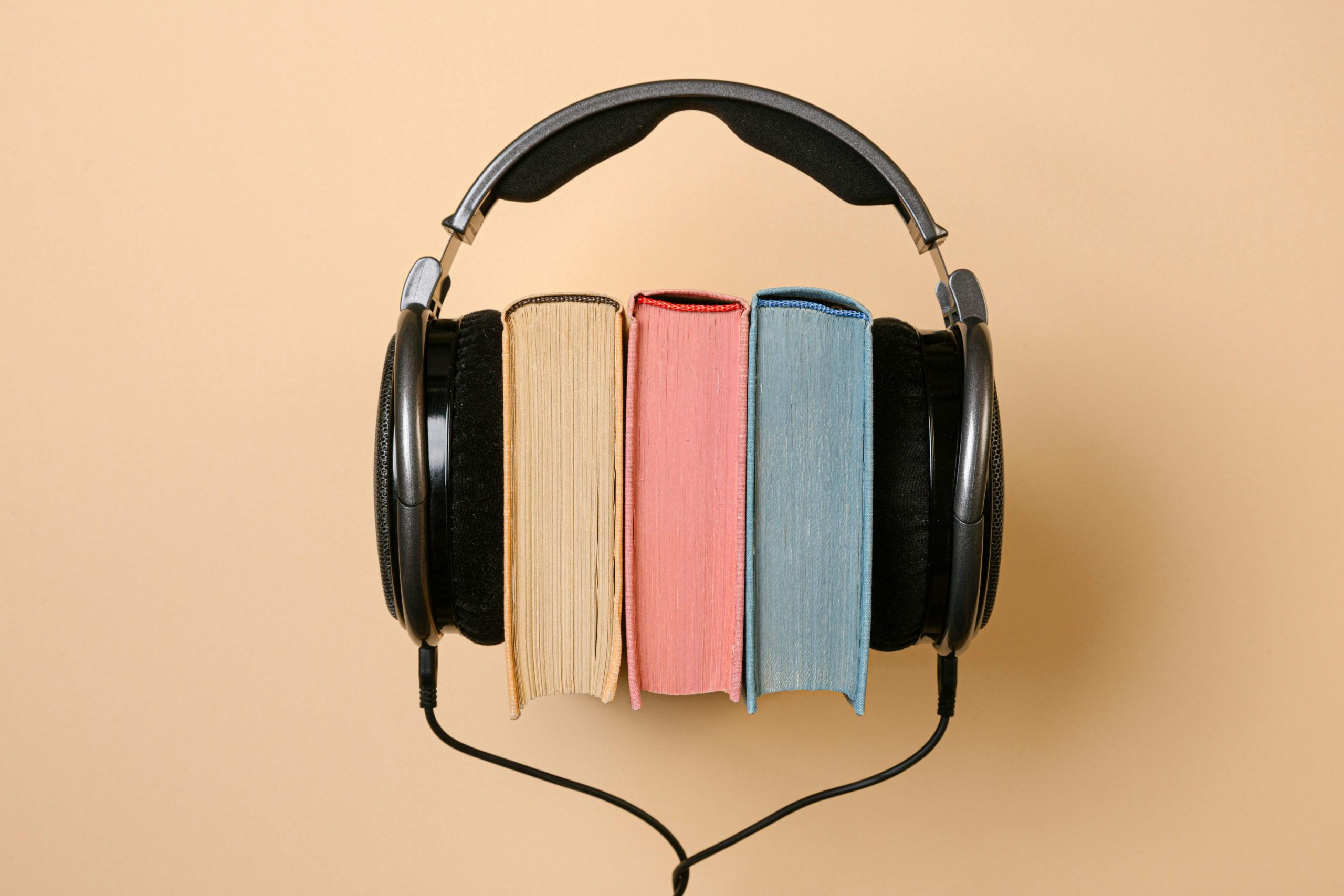
I’ll be the first to admit – audiobooks are a significant portion of my book intake. Sometimes on cd, a yard sale or thrift store find, or a library borrow. Most often, the audiobook is a digital download. Either way, I’ve almost always got one in process, alongside a physical book or three.
But am I reading when I’ve got my earbuds in? Do these books “count?”
You know a tomato’s a fruit, right?
I mean, in the most technical mechanical sense, no, I’m not reading my audiobooks. I’m not visually intaking linguistic symbols from a surface or screen and interpreting their meaning at various levels. But, the better question is, to what degree does that technical difference matter? Am I, as a person who is demonstrably competent at the technical skill of reading, deluding myself and wasting time when I engage with literature outside of that format?
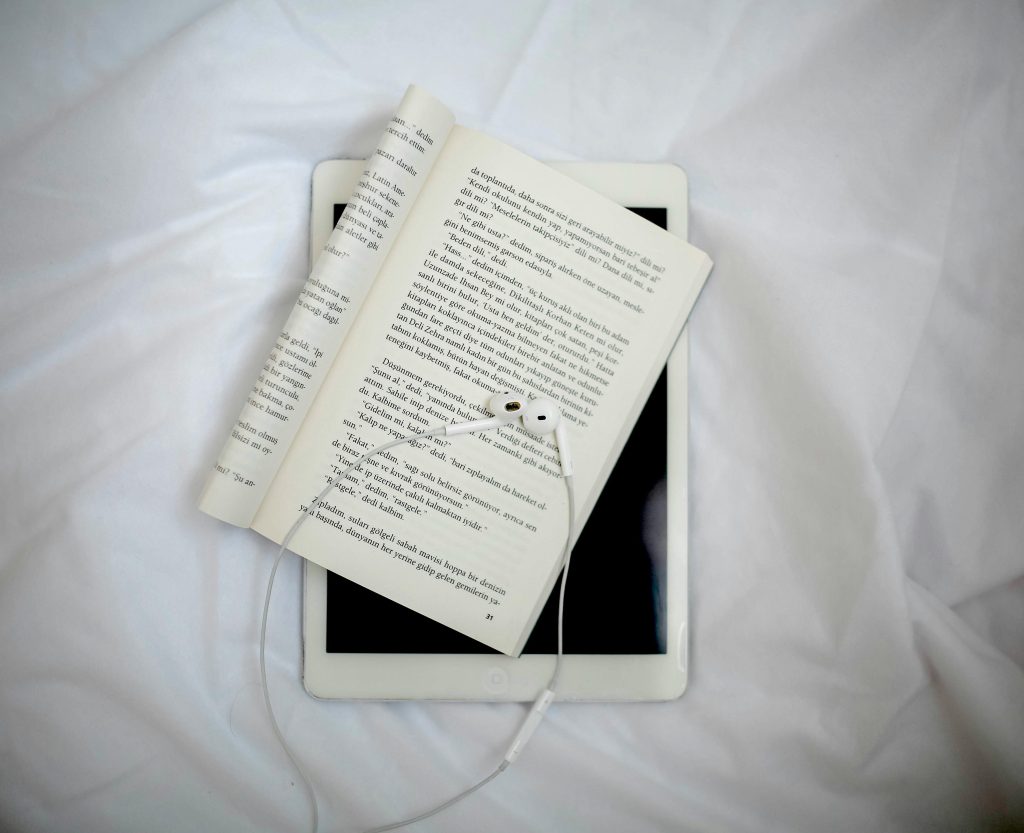
Undoubtedly, the critic who insists that because there are not visible markings involved, nor eyesight necessary, no written word for direct interpretation at all, isn’t wrong to say that listening to an audiobook isn’t “reading” in that narrow technical sense.
Accuracy aside, there’s not much substance in that criticism for me, presuming that one is not just using audiobooks to avoid developing reading as a skill. That argument is on the same footing as knowledge being factoid that a tomato is a fruit, and wisdom being not putting tomatoes in the fruit salad. Unless someone is literally using audiobooks to avoid gaining the necessary skill of interpreting written language on a surface, it doesn’t really matter that any particular book is engaged with auditorially versus visually, as long as the engagement happens.
Stop, Look, and Listen
The hub of debate seems to stem from the issue of linguistic material in visual form, versus the same material in spoken form. This shouldn’t be an either-or decision. Both means of engaging with information and story are valuable and necessary to cultivating literacy and broadening literary horizons. Both forms of reading have historically had their places in education as well as entertainment.
The importance of reading skill has more than enough press without me singing its praises. Reading the written word is obviously a bedrock skill. The ability to read is a prerequisite for being considered to be anything like “educated,” going back deep into antiquity. It goes without saying that you need the ability to recognize and interpret the meaning of words on a page (or screen) in order to function in society. You definitely need the skill to engage with the literary and intellectual heritage of humanity.
That being said, the skill of listening and absorbing and engaging with story and other language-encoded information (as opposed to, say, music, or nature sounds) auditorily is also necessary. If you can’t gather the meaning of spoken words, can’t hold a chain of verbally-expressed ideas in memory long enough to follow it or engage with it, or reiterate it to someone else, you’re going to run into similar issues to those posed by an inability to read written words. These skills are inextricably linked.
Old-School Skill
As vital as writing has been to humanity and the development of culture, learning, commerce, and recording of history, the reality is that humanity’s original means of conveying knowledge and information was verbal. Humans are wired to listen. Our oldest stories, arguably those most deeply imbued with bottomless meaning and timeless applicability, were transmitted orally for far longer than they have existed in written form or adaptation. The epics of Homer come immediately to mind, but also the roots of our fairy tales and the genesis and flood tales that were ancient at humanity’s earliest recorded history.
Somewhat closer to modern times, we have the evidence of reading (and, related in its own way, acted drama) as a group activity and even as family ritual. From the image of the Ingalls family reading together around the cabin fireplace to students in a classroom reading sections of assigned works aloud in turn, it’s hard to argue that there was no expectation or assumption that the listeners got less from the exercise than the direct reader of the text.
Form and Function
It’s not unfair to say that different media for literature have their best uses and contexts. Your mileage may vary here on an individual basis. For myself, the place where the relative value of an audiobook breaks down is deep reading and study. It’s just plain tougher, if not impossible, to flip back and forth, to mark up margins, study, and so forth, in an audiobook versus a physical copy of a work (e-books, for me, rate somewhere in between).
That’s not to say that there’s nothing gleaned from reading, say, Jane Austen’s “Mansfield Park” in audio versus from the page. It all comes down to purpose. I don’t need deep study to be able to understand the story, the various subplots, the characterizations, and so on, even to draw connections and make comparisons between “Mansfield Park” and other Austen works or stories written and set in the same era. The point at which audio’s value breaks down and I would personally require a physical copy would be for the purpose of analyzing the work deeply, perhaps to write a paper or even a detailed review or comparison.
This breakdown is perhaps clearer if you leave the realm of narrative work. Nonfiction has always felt clunky to engage with in audio format. Even popular self-help titles written in a conversational style, much less complex and abstract topics like philosophy, economics, and similar. I wonder if there is a connection between the development of the written word and the expansion of literacy through history with the exploration of abstract topics. Our oldest stuff, the information that we passed down through ages before the written word, is, without exception to my knowledge, bundled in narrative structure even as it conveys much deeper concepts and ideas about more abstract and complicated topics.
Further Objections
Distraction Risk
Another argument against audiobooks as reading centers around an assertion that listening is more easily distracted from than visual copy.
This strikes me as a fairly weak argument, and almost completely individually-dependent. First, there is individual attention span. Different people have greater or lesser attention spans for different media. It’s nearly absurd to decree a particular format of reading invalid based on something so personal.
Additionally, who among us hasn’t caught themself drifting and need to backtrack up a page and reread?
Multitasking Attraction
A further argument is that listening to audiobooks creates an incentive to multitask. More than enough ink has been spilled on the negative outcomes of multitasking; if the goal is attentively absorbing and engaging with language, multitasking isn’t your friend. A handful of paper book or e-reader definitely prevents multitasking.
But what about multitasking that doesn’t so much divide attention? An audiobook while writing an essay is obviously going to shortchange both, but an audiobook while doing something manual and muscle-memory driven is a different combination that seems far less harmful. Mowing the lawn, cleaning the kitchen, folding laundry, and so on can all be done with mental focus on an audiobook. Assuming the listener isn’t still learning them, repetitive manual crafts – knitting, for example – can certainly be done while listening.
Not Exercising a Vital Skill
The last argument I often hear is that choosing an audiobook over a physical copy is simply not exercising the technical skill of reading.
That argument is fair enough, but ultimately pointless. Choosing a physical copy over an audiobook is, alternatively, not exercising the skill of listening. The argument becomes moot. Both skills are valuable and necessary.
Final Verdict: Audiobooks ARE Reading
While they’re less than ideally suited to certain kinds of reading, at the end of the day, an audiobook still counts as reading the book for most general readers’ purposes. Personal preference is absolutely fine, but sidelining the audio format as an invalid means of engaging with a book becomes absurd, quickly.
But, what do you think? Is there an argument for ink on paper that I’ve missed? Some damning stroke against the audio that I’ve neglected?
If you enjoyed this essay, you may also like my book reviews! I recently tackled “Alchemised” by SenLinYu (as an audiobook!), and shared my mixed thoughts on that novel here.
Until next time, may what you’re reading capture your imagination, and may the muse be with you!
Comments are closed.