I’ve been doing a lot of reading (mostly fiction) over the past couple of years, catching up with titles that I “really should read” or “really should give another go,” filling gaps in my literary education, and taking recommendations by the tail. It’s been great going, and I’ve discovered many gems and new favorites along the way (thankfully, very, very few clunkers!). But it’s also got me feeling a little bit reflective and nostalgic about the books that shaped me early in my reading life.
I was “that kid that reads” growing up. Big time. Sitting up in bed reading past bedtime by flashlight. Basking in “library day” at school. Carrying a book with me most everywhere. I can’t even begin to remember all the books that I did read, but there are a number of titles that were on repeat, that truly captured my imagination, and that spurred me on to other ideas that have shaped my life, thinking, and literary taste long past childhood.

The Boxcar Children Series – Gertrude Chandler Warner
This is the first series that I remember being absolutely hooked on, way back in grade school. I think I had a couple of dozen of them on my childhood bookshelf, collecting them as I found them copies at yard sales, and filling in the gaps with trips to the library. The first couple of installments are simply enchanting adventure stories. As the series progresses, the formula becomes more of an episodic mystery series, with the young protagonists as sleuths. Themes of family love and solidarity, independence and self/family reliance, problem-solving and “making do,” and determination are hallmarks of these stories.
Honorable Mention: The Happy Hollisters Series – Jerry West
My mom gave me a nearly-complete set of this series when the local library started running out of “Boxcar” books – there are a lot of similarities between these sleuthing families, although the Hollisters are a bit larger of a clan and with less iconic (?) backstory. I don’t hear much about the Hollisters today, even if a voice occasional calls back to the Aldens of Boxcar fame – if you’ve got a young reader who likes the Boxcar Children, don’t sleep on the Hollisters as a family-friendly mystery series for an audience in grade/early-middle school.
The Saddle Club – Bonnie Bryant
One more high-volume mid-grade series on the list that I’d be remiss if I didn’t include – as a horse-crazy tween girl, I, naturally, read Every. Single. Saddle Club book . That I could get my hands on. While some were mysteries, similar to the later Boxcar Children books, the themes of this series tended to be more tween/teen girls navigating life and growing up and assorted horse-related adventures. I remember this series didn’t shy away from some pretty heavy topics on occasion, but handled in a positive and age-appropriate way.

Harry Potter series – J.K. Rowling
I was in exactly the right age cohort for this series growing up – I was just about 11 years old when I first read “Sorcerer’s Stone,” and pretty much grew up in time with the trio, at a similar age to Harry, Ron, and Hermione with each installment’s release. This was also the series that tipped my interest into learning more about The Hero’s Journey as an archetype, Joseph Campbell’s concept of the monomyth, and the incredible ways that human storytelling works as a craft. This might not be the series that made me a would-be writer…. but it’s fair to say it’s the series that kindled me into a conscious fan as well as a storycraft geek.
A Wrinkle in Time (and its sequels) – Madeleine L’Engle
I first encountered these books about the same time as the Harry Potter series. I might not have grown up to pursue science as a career, but I credit L’Engle’s Time Quartet with instilling my first interest in science fiction as literature (versus it being more of a TV/movie genre for me prior), and a sense of wonder at the scale and depth of possibility across space and time.
The Swiss Family Robinson – Johann David Wyss
I still have my copy of this book from childhood, a gorgeous, slightly battered hardback with absolutely gorgeous full-page pictures that I stared at for absolute ages. The story of the castaway family surviving, settling, and thriving after shipwreck ticked all the boxes that I most liked about the early “Boxcar Children” stories. I apparently had a mild thing for bringing civilized order out of bare necessity.
King of the Wind – Marguerite Henry
I had a hard time choosing just one Margeurite Henry book for this list – there aren’t many that I didn’t read. But King of the Wind has to be the one that I returned to most regularly. A riches-to-rags-to-riches-again story of Sham, an Arabian horse, and his mute groom, Agba, who history would go on to remember as the Godolphin Arabian, one of the founding sires of modern racing thoroughbreds. Henry’s treatment of the history is highly fictionalized, but a wonderful story nonetheless. Wesley Dennis’s gorgeous illustrations (as found in so many of Ms. Henry’s books) are perfection as well.
National Velvet – Enid Bagnold
I often read this story in tandem with King of the Wind… and I remember being shockingly disappointed that The Pie in the 1944 movie was a chestnut horse instead of piebald like the book! The story’s themes of ordinary people rising to extraordinary occasions never fails to uplift and inspire.
The Rolling Stones – Robert Heinlein
This book was my real introduction hard sci-fi, and to Heinlein’s work as well. I eventually discovered and read Heinlein’s more famous and adult-audience titles, including “Starship Troopers” and “Stranger in a Strange Land” later in my teens, but there’s still a very soft spot in my heart for the Stone clan and their adventures… including the proto-Tribble Martian Flat Cats.
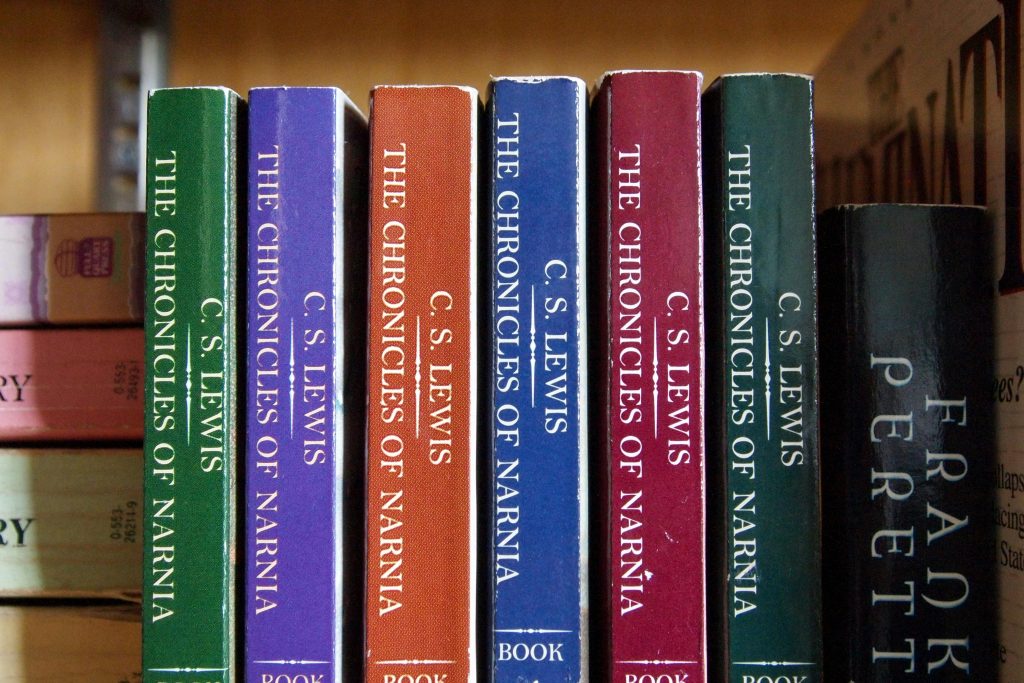
The Chronicles of Narnia – C.S. Lewis
Lewis’s Narnia stories need no introduction from me here…. all I can say is that as much as I enjoyed them as a child, returning to Narnia as an adult has been like going “further up and further in.”
The Sherlock Holmes Stories – Sir Arthur Conan Doyle
I was mildly obsessed with all things Sherlock Holmes during my tweens and early teen years. Looking back, the classic archetypal detective was a natural next step after burning through so many youth-targeted mystery stories with the Aldens and the Hollisters.
The Inheritance Cycle – Christopher Paolini
A dear friend introduced me to Eragon in my early teens, and I absolutely devoured the series. One might, not unfairly, criticize the debut for reading as essentially “A New Hope with dragons,” but the story is still quite serviceable (I’ve already mentioned Campbell’s monomyth, which Lucas famously used as his Star Wars template) does find its own independent wings with the plot developments of books 2-4. I also credit this book with providing me the inspiration to seriously put words on paper myself, at least when I learned that Paolini began work on Eragon as a teenager himself.
The Lord of the Rings – J.R.R. Tolkien
Another that needs no introduction, I first picked up The Fellowship of the Ring at age 13, and never looked back. I think I reread the trilogy a dozen times during my teens, pondered the lore and appendices and the legendarium (and every supporting book I could find on the subject – I have quite the collection) incessantly. I became a veritable Tolkien-nut. Like fellow-Inkling Lewis’s Narnia, it seems like Middle Earth gets richer for me with age.
Final Thoughts
This list is far from an exhaustive catalog of my childhood reading (there were some hard titles to not include!), and I certainly kept on reading a wide variety of genres later into my teens and as an adult. But this little library is a solid snapshot of the stories that I spent most of my pleasure reading enjoying up to my early teens. Some, like Tolkien’s works, remained frequently revisited staples, but in those years I also started exploring stories written for more mature audiences, especially in the horror and sci-fi/fantasy realm. Perhaps I’ll do another post in the future, delving into my reading habits of those more “young adult” reading years of my teens and earliest 20’s.
If you enjoyed this reflection and reminiscing over childhood reading, you may also enjoy my deep-dive into another childhood story staple that continues to find its way into online discourse: was Gaston really the unsung hero of Disney’s “Beauty and the Beast?”. I personally think not. You can check out my argument for Gaston’s legitimate villainy here.
Comments are closed.